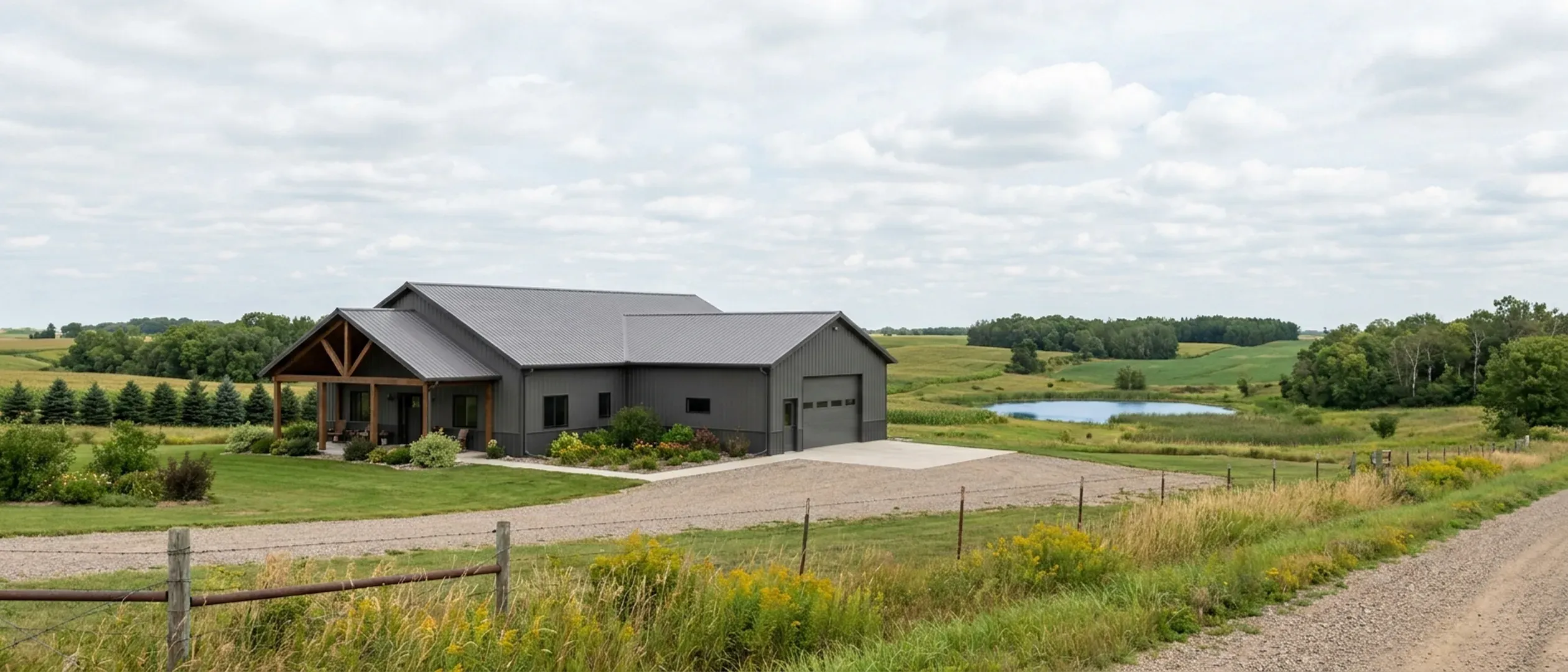
How Big a Barndominium Can You Build in Minnesota for $100,000, $200,000 or More?
The question people ask is how big a barndominium they can build for $100,000 or $200,000. The honest answer starts with subtraction, not division. A Minnesota budget has to cover the land, the septic system, the well and the driveway before a dollar goes to living space, and on a rural lot those lines can take a large share of a small budget. What is left, divided by a realistic price per square foot, gives the floor area. This guide uses the Census Bureau's 2025 figures for houses built on the owner's own land in the Midwest, which includes Minnesota, as that price. It is published data, not our pricing, and none of it is a quote.
Figures below are industry data from cited third-party sources, not a quote from Minnesota Barndominium Builders. Every project is priced individually.
Bottom Line Up Front
- The Census Bureau's 2025 contract price for houses built on the owner's land in the Midwest is $194.09 per square foot at the median and $202.13 on average, land excluded. Divide what is left of your budget by those figures to get a finished floor area.
- On those Census rates, $200,000 covers about 990 to 1,030 finished square feet and $300,000 about 1,480 to 1,550, before land. If part of the budget goes to a septic system, which Scott County puts at about $18,000 to $30,000, the floor area shrinks to match.
- Unfinished shop space costs far less per square foot than finished living space, because interior finishes and the major systems are about 43% of a home's construction cost in NAHB's 2024 survey. Splitting a footprint between shop and home is the main way a budget buys a bigger building.
Published cost figures
Third-party and government figures, each with its source. None of them is a quote, and none of them is ours.
| Measure | Range | Source |
|---|---|---|
| Contractor-built houses on the owner's land, Midwest region, started in 2025: median to average contract price (land excluded) | $194–$202 per sq ft | U.S. Census Bureau, Characteristics of New Housing 2025, Median and Average Contract Price per Square Foot of New Contractor-Built Single-Family Houses Started: Midwest median $194.09, average $202.13 (read 27 Sep 2026) — https://www.census.gov/construction/chars/xls/contractpricesqft_cust.xls |
| Detached new houses sold by builders, Midwest region, 2025: median to average sales price (lot excluded) | $160–$170 per sq ft | U.S. Census Bureau, Characteristics of New Housing 2025, Median and Average Price per Square Foot of Floor Area in Detached New Single-Family Houses Sold: Midwest median $160.00, average $169.78 (read 27 Sep 2026) — https://www.census.gov/construction/chars/xls/soldpricesqft_cust.xls |
| New septic system in Scott County: gravity trench system average to the top of the average mound range | $18,000–$30,000 per system | Scott County (Minnesota), FAQ "How much does a new system cost?": "An average mound will cost around $23,000-$30,000, while a gravity trench system will average about $18,000" (read 27 Sep 2026) — https://www.scottcountymn.gov/Faq.aspx?QID=232 |
| Minnesota agricultural land, 2026 state average: pasture to cropland | $2,400–$7,300 per acre | USDA NASS, Land Values 2026 Summary (released 31 July 2026): Minnesota pasture $2,400, cropland $7,300 per acre (read 27 Sep 2026) — https://www.nass.usda.gov/Publications/Todays_Reports/reports/land0726.pdf |
What actually moves the number
Land comes off the top
USDA's 2026 survey puts Minnesota cropland at $7,300 an acre and pasture at $2,400, as state averages. At those USDA averages, five acres of pasture is about $12,000 and five acres of cropland about $36,500. If you already own the land, that line is gone, and a lender may count its value toward your equity.
Septic and well come next
Off city sewer you need your own septic system. Scott County puts an average mound at about $23,000 to $30,000 and a gravity trench system at about $18,000. A new well adds the Minnesota Department of Health's $325 notification fee plus the drilling, which the well contractor prices for your site.
Shop space is cheaper than living space
Interior finishes (24.1%) and the plumbing, electrical and HVAC rough-ins (19.2%) are about 43% of an average home's construction cost in NAHB's 2024 survey. An unheated shop skips most of that, so the same budget buys more total building when part of it is shop.
Small costs more per square foot
A kitchen, a bathroom, a furnace, a septic system and a driveway cost about the same whether the house is 1,000 or 2,000 square feet. Halving the floor area does not halve the price, so the Census average is a floor for small homes, not a target.
The Arithmetic: Budget, Minus Site Costs, Divided by Price per Square Foot
Three steps turn a budget into a floor area. The figures are published data; the arithmetic is shown so you can redo it with your own numbers.
Step 1: take the land and site costs off the top
Subtract what the land, septic system, well and driveway will cost, unless your builder's price includes them. On a rural Minnesota lot these are real lines: Scott County puts a new septic system at about $18,000 to $30,000, and USDA's 2026 averages put Minnesota pasture at $2,400 an acre and cropland at $7,300.
Step 2: pick a realistic price per square foot
The Census Bureau's 2025 contract price for houses built on the owner's own land in the Midwest is $194.09 per square foot at the median and $202.13 on average, land excluded. That is the closest published match to a custom barndominium on your acreage. Builder spec homes in the Midwest sold for less, $160.00 to $169.78 per square foot in 2025 according to the Census Bureau, but those are built in volume.
Step 3: divide
What is left of the budget divided by the price per square foot is the finished floor area it buys. For example, a $250,000 budget with $30,000 set aside for a mound septic system at the top of Scott County's average range leaves $220,000; at the Census rates of $194 to $202 per square foot that is about 1,090 to 1,130 finished square feet.
How Big a Barndominium Can You Build for $100,000, $200,000, $300,000 or More?
Each line below divides the budget by the Census 2025 Midwest contract price of $194.09 to $202.13 per square foot, rounded. It assumes the land is already paid for and nothing else comes off the top.
$100,000: about 495 to 515 finished square feet
At the Census rates, $100,000 covers roughly 495 to 515 square feet of finished living space. That is a cabin-sized home. On NAHB's shares the shell is about 30% of construction cost, so $100,000 goes much further as a shell or kit with site work, finished later. The barndominium kits page explains what a kit covers.
$200,000: about 990 to 1,030 finished square feet
On the Census figures, $200,000 covers roughly 990 to 1,030 finished square feet, before land. That sits inside the roughly 400 to 1,200 square feet our small barndominium homes plan covers. Take a $30,000 mound septic system, the top of Scott County's average range, out of it and the floor area falls to about 840 to 875 square feet.
$300,000: about 1,480 to 1,550 finished square feet
At the Census rates, $300,000 covers roughly 1,480 to 1,550 finished square feet. A 30x40 barndominium footprint, 1,200 square feet, works out on the Census figures to about $233,000 to $243,000 on the same figures, leaving room for a septic system and well.
$400,000: about 1,980 to 2,060 finished square feet
$400,000 covers roughly 1,980 to 2,060 finished square feet on the Census figures. For comparison, the median contractor-built house completed in the Midwest in 2025 was 2,289 square feet, according to the Census Bureau.
$500,000: about 2,470 to 2,580 finished square feet
At the Census rates, $500,000 covers roughly 2,470 to 2,580 finished square feet, or a 40x60 barndominium finished throughout. Split the same footprint between living space and a shop and the budget stretches further, because a shop skips most interior finishes and systems.
Getting More Building for the Money
These change the size a budget buys without pretending the per-square-foot figure is lower than it is.
Split the footprint: home plus shop
Interior finishes and the major systems rough-ins are about 43% of an average home's construction cost in NAHB's 2024 survey. A heated, finished home under the same roof as an unfinished shop spends that 43% only on the home half. A shouse is built around that idea.
Keep the shape simple
Framing is 16.6% of construction cost and exterior finishes 13.4% in NAHB's survey. A plain rectangle under one roof, which is what a barndominium usually is, keeps both lines down compared with a house of many corners and rooflines. A pole barn home uses that geometry.
Finish in stages
Some owners close in the full shell and finish part of the interior first. Minnesota exempts owners who build a home they will live in from the residential contractor licence, but electrical and plumbing rules still apply statewide, and a lender may require the home to be complete before the permanent loan. The financing guide covers how lenders handle that.
Price the site before the house
The land, septic, well and driveway decide how much of the budget is left for floor area. On a lot near a lake, the county's shoreland setbacks also decide where the house and drainfield can go (Minn. R. 6120.3300). A site preparation review before you settle on a plan avoids designing a house the lot cannot hold.
Small Barndominium Homes in Minnesota
A small plan is where budget and size meet most directly.
What small buys
Our small plan covers roughly 400 to 1,200 square feet of living space, which fits one or two bedrooms and an open living area. At the Census 2025 Midwest rates, 1,000 finished square feet is about $194,000 to $202,000 before land, and in practice more per square foot than a larger home because the fixed costs do not shrink.
Where to look next
See our small barndominium homes plan and the 30x40 barndominium plan for layouts in that range, and the barndominium cost guide for the full cost picture.
Reading this because you are weighing a build? The next step is a plan drawn for your program.
What's different about Minnesota
Frost footings and snow load are set by county
Minnesota's rules set a minimum frost footing depth of 5 feet in Zone I counties and 3-1/2 feet in Zone II counties (Minn. R. 1303.1600), and a ground snow load of 60 pounds per square foot in 29 counties and 50 in the rest (Minn. R. 1303.1700). The same floor plan costs more to found and roof in a 5-foot, 60-pound county, so the size a budget buys depends on where you build.
Septic sizing follows bedrooms
Septic systems are permitted and inspected under your county's SSTS ordinance, or your city's or township's where it has its own, to MPCA rules, and designed by MPCA-licensed professionals (Minn. Stat. §§ 115.55, 115.56). State law bars a building permit for adding a bedroom on property served by a system until the system has been inspected, so plan bedrooms and septic together from the start.
Owner-builders and the trades
Minnesota exempts owners who build a home they will live in from the residential building contractor licence (Minn. Stat. § 326B.805, subd. 6). That can stretch a budget if you finish part of the work yourself, but Minnesota's electrical and plumbing rules apply statewide, whether or not your township enforces the building code (Minn. R. 1300.0010).
How big of a barndominium can I build for $100,000 in Minnesota?
How big of a barndominium can I build for $200,000?
How big of a barndominium can I build for $300,000?
Does a shop count against my budget the same way?
Why do small barndominiums cost more per square foot?
Should I set aside money for septic before planning the size?
Can I build it myself to get more space for the money?
Questions answered? Tell us what you want to build and we will put real numbers against it.
Sources
- U.S. Census Bureau — Median and Average Contract Price per Square Foot of New Contractor-Built Single-Family Houses Started (Characteristics of New Housing, 2025) — Midwest 2025: median $194.09, average $202.13 per sq ft, lot excluded. Read 27 Sep 2026.
- U.S. Census Bureau — Median and Average Price per Square Foot of Floor Area in Detached New Single-Family Houses Sold (Characteristics of New Housing, 2025) — Midwest 2025: median $160.00, average $169.78, lot excluded. Read 27 Sep 2026.
- U.S. Census Bureau — Median and Average Square Feet of Floor Area in New Single-Family Houses Completed: Contractor-Built (Characteristics of New Housing, 2025) — Midwest 2025: median 2,289 sq ft. Read 27 Sep 2026.
- NAHB — Cost of Constructing a Home, 2024 (Eric Lynch, January 20, 2025) — Table 1 construction cost shares. National averages. Read 27 Sep 2026.
- USDA National Agricultural Statistics Service — Land Values 2026 Summary (July 31, 2026) — Minnesota 2026: cropland $7,300, pasture $2,400 per acre. Read 27 Sep 2026.
- Scott County (Minnesota) — FAQ: How much does a new system cost? — Average mound about $23,000 to $30,000; gravity trench about $18,000. Read 27 Sep 2026.
- Minnesota Pollution Control Agency — 2025 Subsurface Sewage Treatment Systems Annual Report (wq-wwists1-69, April 2026) — Residential SSTS permits by type, 2025. Read 27 Sep 2026.
- Minnesota Department of Health — Wells and Borings fee schedule — Water-supply well notification: $325. Read 27 Sep 2026.
- Minn. Stat. § 115.55 — Subsurface Sewage Treatment Systems
- Minn. Stat. § 326B.805 — Licensing of residential building contractors (subd. 6, exemptions)
- Minn. R. 1300.0010 — Administration of the State Building Code (statewide plumbing and electrical enforcement)
- Minn. R. 1303.1600 — Footing Depth for Frost Protection
- Minn. R. 1303.1700 — Ground Snow Load
- Minn. R. ch. 6120 — Shoreland and Floodplain Management
Keep reading
The pages that answer the next question this one raises.
Small barndominium homes
Compact layouts for a smaller budget.
Read itBarndominium cost in Minnesota
Census price per square foot, a size table, land, septic and frost-footing costs.
Read itBarndominium financing
How construction-to-permanent, USDA, FHA and VA loans treat a build.
Read itStart the survey
Tell us your budget and your land, and we will size a plan to both.
Read itWant a real number instead of a range?
Start the survey and tell us about your land and what you want to build. Include the county and township, or the parcel number if you have it, because in Minnesota the zoning, the shoreland rules, the septic system and the well can change the budget more than the building does. The survey costs nothing.