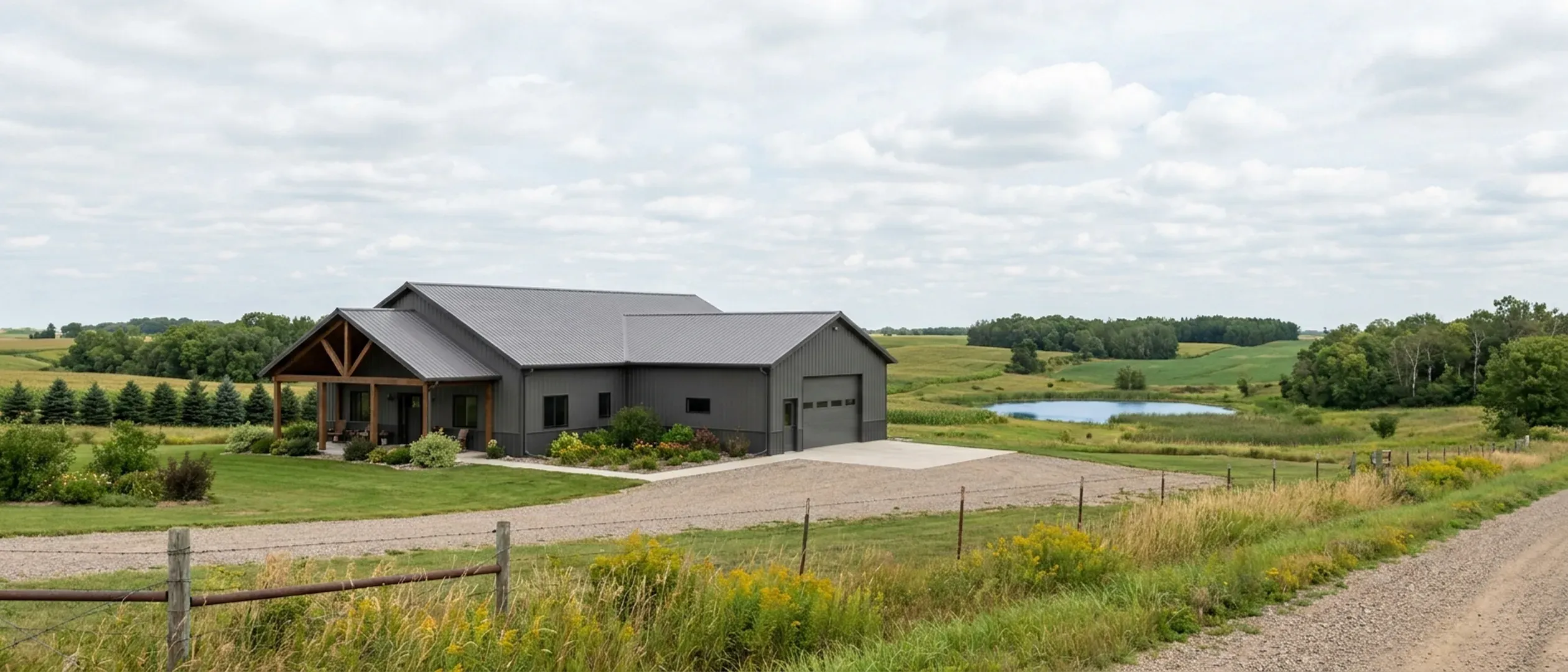
Barndominium Financing in Minnesota
Most barndominiums are financed the way any custom home is: with a construction loan that becomes a mortgage when the house is finished. What makes a barndominium different is not the loan type but the questions lenders ask along the way: whether the appraiser can find comparable sales, whether the site is rural enough for a USDA guarantee and not so agricultural that it is excluded, whether the builder meets the lender's requirements, and whether a township that does not enforce the building code can still produce the completion document a lender needs. This guide sets out the main loan types from the rules and lender pages that govern them. It is not financial advice, we are not a lender, and nothing here is a rate quote.
Figures on this page are cited third-party or government data, not a quote from Minnesota Barndominium Builders.
Bottom Line Up Front
- The usual route is a single-closing construction-to-permanent loan. Under Fannie Mae's rules, no single construction period may exceed 12 months and the total may not exceed 18, and if you already own the lot the loan-to-value ratio is measured against the home's "as completed" appraised value, so land equity counts.
- USDA's guaranteed loan can finance construction on a rural site, lot included, but the regulations exclude property "used primarily for agriculture, farming or commercial enterprise" and income-producing buildings, which matters for a barndominium with a working shop.
- Farm Credit lenders serving Minnesota, including AgCountry and Compeer, publish construction loans that name barndominiums. Minnesota Housing's mortgage programs can be the permanent loan, but they require a finished home with a certificate of occupancy or equivalent before closing.
What actually moves the number
The appraisal
Lenders size the loan against an appraised value. For a single-closing construction-to-permanent loan sold to Fannie Mae, the appraisal's effective date must be no more than four months before closing, and a completion report is required when construction is finished (Fannie Mae Selling Guide B5-3.1-02).
The land
Owning the land helps. Under Fannie Mae's single-closing rules, a borrower who already owns the lot has the loan-to-value ratio measured against the as-completed value of lot and home, and AgCountry's construction loan page says it acknowledges the equity in the land.
The builder
Lenders vet the builder as well as the borrower. USDA's guaranteed construction loans require a builder with two or more years of experience building single-family homes, any state or local licences required, and at least $500,000 of commercial general liability insurance (7 CFR 3555.105).
The schedule
Construction loans have clocks. Fannie Mae caps a single-closing construction period at 12 months with a total of 18, and AgCountry's Rural 1st construction loans allow up to one year to finish. A Minnesota winter belongs in that schedule.
Barndominium Loans: How Minnesota Builds Are Paid For
The Census Bureau tracks how contractor-built houses on owners' land are financed. In the Midwest in 2025 the split was clear.
Conventional loans: about two-thirds
Of the roughly 27,000 contractor-built houses started in the Midwest in 2025, 66% were financed with conventional loans, according to the Census Bureau. In most of the country, Fannie Mae and Freddie Mac can buy one-unit loans up to $832,750 in 2026 (FHFA).
Cash: about a third
31% of those Midwest contractor-built houses were paid for in cash, the Census Bureau reports.
FHA and VA: small shares, real options
FHA-insured loans financed 2% and VA-guaranteed loans 1% of Midwest contractor-built starts in 2025, per the Census Bureau. Both can be used to build: VA says its purchase loans can help veterans "buy, build, or improve a home".
Rates move weekly
Freddie Mac's Primary Mortgage Market Survey put the average 30-year fixed rate at 7.03% for the week of 24 September 2026. Construction loans are priced by each lender; Compeer Home's construction page, for example, describes locking the interest rate up front to protect against rate changes during construction.
Construction-to-Permanent Loans
A construction-to-permanent loan pays the builder in draws while the barndominium goes up, then becomes a mortgage. Fannie Mae's Selling Guide sets the rules many lenders follow.
Single close or two closings
Fannie Mae describes two structures: a single-closing transaction, where the construction loan and the permanent mortgage close together, and a two-closing transaction with separate loans. Fannie Mae buys a single-closing loan only after construction is complete and the loan has converted to permanent financing.
The 12- and 18-month limits
For a single-closing loan, "no single period of more than 12 months" of construction is allowed and "the total period may not exceed 18 months", including extensions (Fannie Mae Selling Guide B5-3.1-02). A barndominium that starts in late fall and waits out the frost needs that time accounted for.
If you already own the land
When the borrower owns the lot at the first construction advance, Fannie Mae treats the loan as a limited cash-out refinance and divides the loan amount by the as-completed appraised value of lot and home. When the borrower is buying the lot, the loan is divided by the lesser of the total purchase price (construction plus lot) or the as-completed value.
Draws and inspections
Construction money is released in stages as work is completed and checked. USDA's rule for guaranteed construction loans, for example, requires the borrower's written approval before each draw and the lender's confirmation that the work is done before releasing it (7 CFR 3555.105).
USDA Loans for Rural Minnesota
USDA Rural Development guarantees home loans in areas it designates as rural,. Eligibility is by address, so check a specific parcel on USDA's eligibility site.
Construction is an eligible purpose
USDA's guaranteed-loan rules list "the construction or purchase of a new dwelling" as an eligible use, along with site preparation such as grading, foundation and the driveway (7 CFR 3555.101). A combination construction and permanent loan can include the price of the lot (7 CFR 3555.105).
The site must be modest and not a working farm
The site must be "typical for the area", with all-weather road access and adequate water and wastewater systems, and it "must not include income-producing land or buildings to be used principally for income-producing purposes". Property "used primarily for agriculture, farming or commercial enterprise is ineligible" (7 CFR 3555.201). A home with a personal shop is one thing; a barndominium on a working farm or with a business in the shop is another.
The builder has to qualify
Builders on USDA guaranteed construction loans need two or more years of experience building single-family homes, any state or local licences required, and commercial general liability insurance of at least $500,000. Contractors building their own residence are ineligible (7 CFR 3555.105).
Income and address limits
USDA loans have household income limits and address eligibility. Both can be checked on USDA's Income and Property Eligibility site before you buy land.
FHA, VA, Farm Credit and Minnesota Housing
Beyond conventional and USDA loans, four other routes come up for Minnesota barndominiums.
FHA
FHA-insured loans are capped by county. HUD's 2026 limits set a one-unit floor of $541,287 for low-cost areas (Mortgagee Letter 2025-23); your county's figure is on HUD's lookup. FHA financed 2% of Midwest contractor-built starts in 2025, per the Census Bureau.
VA
VA-backed loans can be used to build a home, and VA notes the program does not require a down payment or monthly mortgage insurance, though a one-time funding fee may apply. Ask early whether your lender offers VA construction financing.
Farm Credit
AgCountry Farm Credit Services' Rural 1st construction loans offer a one-time close, up to one year to complete the project, and say they finance barndominium and log home builds. Compeer Home, a division of Compeer Financial, lists specialized construction loans for barndominiums and lets clients act as their own general contractor.
Minnesota Housing
Minnesota Housing's Start Up and Step Up first-mortgage programs work through participating lenders. For new construction, the Step Up manual requires residential zoning, a certificate of occupancy or legal document confirming the home is safe to inhabit before closing, and that the borrower not act as general contractor. In practice that makes them a permanent loan for a finished home, not construction financing.
Reading this because you are weighing a build? The next step is a plan drawn for your program.
What's different about Minnesota
Where no one enforces the building code
Minnesota's State Building Code applies everywhere, but it is enforced with permits and inspections only where a city, township or county has adopted it (Minn. Stat. § 326B.121). Lenders and programs that need proof of completion, such as Minnesota Housing's requirement for a certificate of occupancy or a legal document confirming the house is safe to inhabit, may need a different document in a township that does not issue one. Ask the lender what it will accept before you start.
Minnesota Housing's programs
Minnesota Housing offers the Start Up program for first-time homebuyers and the Step Up program for other low- and moderate-income buyers, through participating lenders. Its September 2026 Step Up procedural manual requires a new-construction home to be on residentially zoned land, to have a certificate of occupancy or equivalent before closing, and bars the borrower from acting as the general contractor.
Farm Credit in Minnesota
The Farm Credit institutions listed for Minnesota include AgCountry Farm Credit Services and Compeer Financial. Both publish rural construction loans: AgCountry's Rural 1st says it finances barndominium builds with a one-time close, and Compeer Home lists specialized construction loans for barndominiums.
Green Acres land used as collateral
If your land is enrolled in Green Acres, ask the county assessor before you build. Land that leaves the program owes up to three years of deferred tax (Minn. Stat. § 273.111), which is worth knowing before a lender values the parcel.
Can you get a mortgage for a barndominium in Minnesota?
What is a construction-to-permanent loan?
Can I use a USDA loan to build a barndominium in Minnesota?
Does owning my land help me finance a barndominium?
Can I use an FHA or VA loan for a barndominium?
Do Farm Credit lenders finance barndominiums in Minnesota?
Can a Minnesota Housing loan pay for building a barndominium?
How much do I need down to build a barndominium?
Questions answered? Tell us what you want to build and we will put real numbers against it.
Sources
- Fannie Mae Selling Guide — B5-3.1-02, Conversion of Construction-to-Permanent Financing: Single-Closing Transactions — 12/18-month limits, LTV calculation, appraisal age. Read 27 Sep 2026.
- U.S. Census Bureau — Contractor-Built Houses Started by Type of Financing (Characteristics of New Housing, 2025) — Midwest 2025: conventional 66%, FHA 2%, VA 1%, cash 31%. Read 27 Sep 2026.
- eCFR — 7 CFR 3555.101, Loan purposes — Read via the eCFR API, 27 Sep 2026.
- eCFR — 7 CFR 3555.105, Combination construction and permanent loans — Lender and builder requirements. Read via the eCFR API, 27 Sep 2026.
- eCFR — 7 CFR 3555.201, Site requirements — Rural areas; income-producing and agricultural property ineligible. Read via the eCFR API, 27 Sep 2026.
- USDA — Income and Property Eligibility Site
- HUD — Mortgagee Letter 2025-23, 2026 Nationwide Forward Mortgage Loan Limits — Low-cost area one-unit limit $541,287. Read 27 Sep 2026.
- FHFA — FHFA Announces Conforming Loan Limit Values for 2026 — 2026 one-unit baseline $832,750. Read 27 Sep 2026.
- Freddie Mac — Primary Mortgage Market Survey, historical data — 30-year fixed 7.03% for the week of 9/24/2026. Read 27 Sep 2026.
- VA.gov — VA-backed purchase loan — "buy, build, or improve a home"; funding fee. Read 27 Sep 2026.
- AgCountry Farm Credit Services — Rural Construction Loans — One-time close; up to one year; finances barndominium builds. Read 27 Sep 2026.
- Compeer Home — One-Time Close Construction Loans — Specialized construction loans for barndominiums; own-general-contractor option. Read 27 Sep 2026.
- Farm Credit — Minnesota — Farm Credit institutions in Minnesota. Read 27 Sep 2026.
- Minnesota Housing — Step Up Program Procedural Manual (September 1, 2026) — Section 5.05, New Construction Property Requirements. Read 27 Sep 2026.
- Minn. Stat. § 326B.121 — Compliance with State Building Code
- Minn. Stat. § 273.111 — Agricultural property tax (Green Acres).
Keep reading
The pages that answer the next question this one raises.
Barndominium cost in Minnesota
What lenders will be looking at: Census price per square foot, land, septic and site costs.
Read itHow big can you build for your budget?
From a loan amount to a floor area.
Read itBuild timeline
How long a Minnesota build takes, against a construction loan's clock.
Read itStart the survey
Tell us about your land and budget before you talk to a lender.
Read itWant a real number instead of a range?
Start the survey and tell us about your land and what you want to build. Include the county and township, or the parcel number if you have it, because in Minnesota the zoning, the shoreland rules, the septic system and the well can change the budget more than the building does. The survey costs nothing.