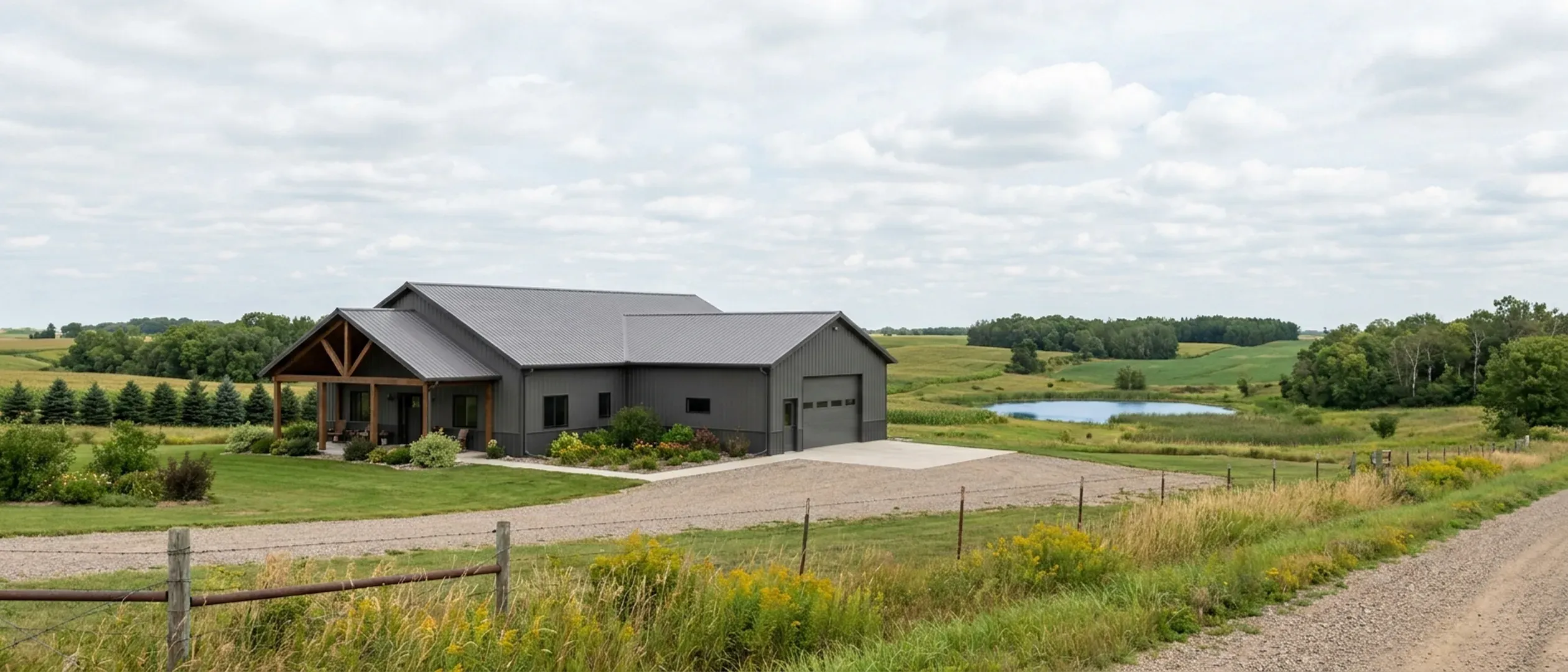
How Much Does It Cost to Build a Barndominium in Minnesota?
Nobody publishes a measured cost for building a barndominium in Minnesota, and a page that hands you one statewide price per square foot is guessing. What does exist is better than a guess. The Census Bureau measures what owners pay a general contractor to build a house on land they already own, and it reports the Midwest region, which includes Minnesota, on its own. The Census permit survey shows what Minnesota's new single-family homes were valued at when permitted in 2025. USDA publishes what an acre of Minnesota cropland and pasture is worth, Scott County publishes what a new septic system costs there, and the Minnesota Department of Health publishes its well fee. This guide puts those figures side by side, each with its source, and shows where Minnesota's own rules on frost footings, snow load, radon, septic and shoreland add lines that a national average leaves out. None of it is our pricing, and none of it is a quote.
Figures below are industry data from cited third-party sources, not a quote from Minnesota Barndominium Builders. Every project is priced individually.
Bottom Line Up Front
- The closest published benchmark is the Census Bureau's 2025 figure for contractor-built houses on the owner's own land in the Midwest: a median contract price of $194.09 per square foot and an average of $202.13, with the land excluded. At those Census rates a 2,000 sq ft home works out to roughly $388,000 to $404,000 before land, and before any septic, well or driveway work the contract leaves out.
- Minnesota's rules add real lines: Minnesota Rules 1303.1600 sets a minimum frost footing depth of 5 feet in 34 counties, mostly in the north, and 3-1/2 feet in the other 53; Minn. R. 1303.1700 sets a ground snow load of 60 pounds per square foot in 29 counties, and a passive radon system in every new home.
- Off city sewer, the septic system is its own budget line. Scott County puts an average mound at about $23,000 to $30,000 and a gravity trench system at about $18,000, and mounds were the most common type of new residential system permitted in Minnesota in 2025 according to the MPCA.
Published cost figures
Third-party and government figures, each with its source. None of them is a quote, and none of them is ours.
| Measure | Range | Source |
|---|---|---|
| Contractor-built houses on the owner's land, Midwest region, started in 2025: median to average contract price (land excluded) | $194–$202 per sq ft | U.S. Census Bureau, Characteristics of New Housing 2025, Median and Average Contract Price per Square Foot of New Contractor-Built Single-Family Houses Started: Midwest median $194.09, average $202.13 (read 27 Sep 2026) — https://www.census.gov/construction/chars/xls/contractpricesqft_cust.xls |
| Detached new houses sold by builders, Midwest region, 2025: median to average sales price (lot excluded) | $160–$170 per sq ft | U.S. Census Bureau, Characteristics of New Housing 2025, Median and Average Price per Square Foot of Floor Area in Detached New Single-Family Houses Sold: Midwest median $160.00, average $169.78 (read 27 Sep 2026) — https://www.census.gov/construction/chars/xls/soldpricesqft_cust.xls |
| Average construction cost alone (no lot, overhead, marketing or profit), national builder survey, 2024 | $162 per sq ft | NAHB, Cost of Constructing a Home 2024 (January 2025): average construction cost $428,215, about $162 per square foot; national averages only (read 27 Sep 2026) — https://www.nahb.org/-/media/NAHB/news-and-economics/docs/housing-economics-plus/special-studies/2025/special-study-cost-of-constructing-a-home-2024-january-2025.pdf |
| Contractor-built houses on the owner's land, Midwest region, started in 2025: median to average contract price per house (land excluded) | $457,200–$546,100 per home | U.S. Census Bureau, Characteristics of New Housing 2025, Median and Average Contract Price of New Contractor-Built Single-Family Houses Started: Midwest median $457,200, average $546,100 (read 27 Sep 2026) — https://www.census.gov/construction/chars/xls/contractprice_cust.xls |
| Average permit valuation per new single-family home authorized in Minnesota, 2025 (structure only, as declared on the permit) | $373,100 per home | U.S. Census Bureau, Building Permits Survey, annual 2025 state data: Minnesota 1-unit valuation $4,807,806 thousand across 12,886 units, about $373,100 each (arithmetic; read 27 Sep 2026) — https://www.census.gov/construction/bps/xls/stateannual_202599.xls |
| Minnesota agricultural land, 2026 state average: pasture to cropland | $2,400–$7,300 per acre | USDA NASS, Land Values 2026 Summary (released 31 July 2026): Minnesota pasture $2,400, cropland $7,300, all farm real estate $6,950 per acre (read 27 Sep 2026) — https://www.nass.usda.gov/Publications/Todays_Reports/reports/land0726.pdf |
| New septic system in Scott County: gravity trench system average to the top of the average mound range | $18,000–$30,000 per system | Scott County (Minnesota), FAQ "How much does a new system cost?": "An average mound will cost around $23,000-$30,000, while a gravity trench system will average about $18,000" (read 27 Sep 2026) — https://www.scottcountymn.gov/Faq.aspx?QID=232 |
| Minnesota Department of Health well construction notification fee, water-supply well | $325 per well | Minnesota Department of Health, Wells and Borings fee schedule: Well Construction Notifications, Water-Supply Well $325 (read 27 Sep 2026) — https://www.health.state.mn.us/communities/environment/water/wells/feesched.html |
Total cost by size
Rough totals at common sizes. These move with everything on this page, so treat them as a starting orientation, not an estimate for your project.
1,500 sq ft
$291,000–$303,000
Arithmetic, rounded to the nearest $1,000: 1,500 sq ft × the Census 2025 Midwest contract price per sq ft for contractor-built houses ($194.09 median, $202.13 average), which exclude the lot — https://www.census.gov/construction/chars/xls/contractpricesqft_cust.xls
2,000 sq ft
$388,000–$404,000
Arithmetic, rounded to the nearest $1,000: 2,000 sq ft × the Census 2025 Midwest contract price per sq ft for contractor-built houses ($194.09 median, $202.13 average), which exclude the lot — https://www.census.gov/construction/chars/xls/contractpricesqft_cust.xls
2,500 sq ft
$485,000–$505,000
Arithmetic, rounded to the nearest $1,000: 2,500 sq ft × the Census 2025 Midwest contract price per sq ft for contractor-built houses ($194.09 median, $202.13 average), which exclude the lot — https://www.census.gov/construction/chars/xls/contractpricesqft_cust.xls
3,000 sq ft
$582,000–$606,000
Arithmetic, rounded to the nearest $1,000: 3,000 sq ft × the Census 2025 Midwest contract price per sq ft for contractor-built houses ($194.09 median, $202.13 average), which exclude the lot — https://www.census.gov/construction/chars/xls/contractpricesqft_cust.xls
What actually moves the number
The finish schedule, not the frame
In NAHB's 2024 national survey of builders, framing including trusses and sheathing is 16.6% of construction cost, while interior finishes are 24.1% and the plumbing, electrical and HVAC rough-ins are 19.2%. A barndominium's steel or pole barn shell changes the first of those lines. Cabinets, flooring, fixtures, drywall and the mechanical systems cost what they cost in any house.
Frost footings
Minnesota's rule sets the minimum footing depth for frost at 5 feet in Zone I counties and 3-1/2 feet in Zone II counties, unless an engineer competent in soil mechanics shows a lesser depth will work (Minn. R. 1303.1600). Deeper footings mean more excavation and concrete, and NAHB puts excavation, foundation and concrete at 10.0% of an average home's construction cost before any frost adjustment.
Snow load on a wide roof
The state sets the ground snow load by county: 60 pounds per square foot in 29 listed counties and 50 in the rest (Minn. R. 1303.1700). A barndominium's clear-span roof is designed from that figure, so truss and purlin sizing follows the county you build in.
Septic and well
Most rural lots need their own septic system and well. Scott County puts an average mound at about $23,000 to $30,000 and a gravity trench system at about $18,000. The Minnesota Department of Health charges $325 to file a new water-supply well, and the drilling is priced by the well contractor for your site.
Barndominium Cost per Square Foot in Minnesota
There is no Census figure for barndominiums, and none for Minnesota alone. These are the published measures that come closest, and what each one leaves out.
Houses built on the owner's own land: $194 to $202 per sq ft
The Census Bureau's 2025 figures for contractor-built houses in the Midwest, meaning a house built for the owner on the owner's land by a general contractor, are a median contract price of $194.09 per square foot and an average of $202.13. The land is excluded. This is the closest match to a custom barndominium on your own acreage, because it is the same buying arrangement.
Builder spec houses: $160 to $170 per sq ft
New detached houses sold by builders in the Midwest in 2025 had a median price of $160.00 per square foot and an average of $169.78, lot excluded, according to the Census Bureau. Those are tract and spec homes built in volume. A one-off rural build rarely gets that efficiency, which is part of why the contractor-built figure above is higher.
Construction cost alone: about $162 per sq ft, nationally
NAHB's 2024 survey of builders put the average construction cost of a new single-family home at $428,215, or about $162 per square foot, excluding the lot, financing, overhead and profit. NAHB says its sample is too small for a regional breakdown, so treat it as a national yardstick, not a Minnesota price.
What Minnesota's new homes were valued at: about $373,100
Minnesota issued permits for 12,886 new single-family homes in 2025, with a total declared valuation of $4.81 billion, according to the Census Building Permits Survey. That is about $373,100 per home for the structure, as declared on the permits. Permit valuations are what applicants declare, so they tend to run below final cost.
What a 1,500, 2,000 and 2,500 sq ft Barndominium Costs
The size table on this page multiplies each size by the Census 2025 Midwest price per square foot for houses built on the owner's land. It is arithmetic from a published figure, not a quote. The Census contract price excludes the lot; whether a septic system, well and driveway sit inside a contractor's price varies, so check before you compare.
1,500 sq ft: roughly $291,000 to $303,000
At the Census 2025 Midwest median of $194.09 and average of $202.13 per square foot, 1,500 square feet of finished living space works out to about $291,000 to $303,000 before land. Smaller homes often cost more per square foot, because the kitchen, bathrooms and mechanical systems do not shrink with the floor area. See the small barndominium floor plan for what fits in that footprint.
2,000 sq ft: roughly $388,000 to $404,000
The same Census figures put 2,000 finished square feet at about $388,000 to $404,000. For comparison, the median contractor-built house completed in the Midwest in 2025 was 2,289 square feet, according to the Census Bureau.
2,500 sq ft: roughly $485,000 to $505,000
At 2,500 finished square feet the Census-based arithmetic gives about $485,000 to $505,000. That sits close to the Census 2025 Midwest median contract price of $457,200 per contractor-built house, which covered a median of 2,289 square feet.
3,000 sq ft: roughly $582,000 to $606,000
3,000 finished square feet works out to about $582,000 to $606,000 on the Census figures. If part of that space is an unheated shop rather than finished living space, the real number is lower, because a shop needs a slab, walls, a roof and doors but not the interior finishes and systems that NAHB puts at over 40% of a home's construction cost.
What does a 40x60 barndominium cost?
A 40x60 building is 2,400 square feet. Finished entirely as living space at the Census 2025 Midwest contractor-built rates, that is about $466,000 to $485,000 before land. Many 40x60 plans split the footprint between living space and a shop, which changes the number a great deal. See the 40x60 barndominium plan.
Kit Price vs Turnkey Price
A barndominium kit and a finished barndominium are different purchases. The gap between them is most of the house.
What a kit covers
A kit is usually the structural shell: frame, roof and wall panels or sheathing, trim and fasteners, sometimes doors and windows. In NAHB's 2024 survey, framing (16.6%) and exterior finishes including roofing, siding, windows and doors (13.4%) together make up about 30% of an average home's construction cost. That is the part of the budget a kit price speaks to.
What a kit leaves out
Foundation, site work, septic, well, the plumbing, electrical and HVAC systems, insulation, drywall, cabinets, flooring and fixtures are outside most kits. In NAHB's survey the interior finishes and the major systems rough-ins alone are about 43% of construction cost, and foundations another 10.5%. Compare a kit price with a finished-home price only after adding those lines back. Our barndominium kits page explains what a kit package includes.
Sales tax is part of the materials cost
Minnesota sales tax applies to building materials and kits, whether a homeowner or a contractor buys them, so it is part of your materials cost (Minn. Stat. § 297A.61, subd. 4(d)). Budget for it on the kit invoice and on every materials order.
Turnkey means one price for the whole list
A turnkey build prices the shell, the site work and the interior together, so the comparison with a house is like for like. It is also the only way to see the real cost per square foot of your plan, because the shell price alone understates it by more than half on NAHB's shares.
Pole Barn Home Cost
Pole barn framing changes how the building stands up. It does not change what goes inside it.
Where the frame sits in the budget
NAHB's 2024 survey puts framing, including the roof structure, trusses and sheathing, at 16.6% of an average home's construction cost. A pole barn home uses fewer, larger members on wide spacing, which can change that line. The other 83% of construction cost is the same list as any house.
Stick framing is still the Midwest norm
Of the contractor-built houses completed in the Midwest in 2025, 96% were wood-framed and 2% steel-framed, according to the Census Bureau.
Frost and snow apply to every frame
Minnesota's frost-depth rule sets the minimum footing depth for the home's foundation however it is framed, and the county's ground snow load sets the roof design. A pole barn home in a 5-foot, 60-pound county is engineered for more than the same plan in a 3-1/2-foot, 50-pound county.
What Drives Cost in Minnesota: Frost Footings, Snow Load, Energy Code, Septic, Well and Site Work
The frame is rarely what makes a Minnesota barndominium expensive. These are the lines that move.
Frost footings by county
Minn. R. 1303.1600 puts every county in one of two frost zones: 5 feet in Zone I, which includes St. Louis, Itasca, Crow Wing and Douglas counties, and 3-1/2 feet in Zone II, which includes Hennepin, Stearns, Olmsted and Blue Earth counties. A soils engineer can justify less. An extra 18 inches of footing depth around a large footprint adds excavation and concrete.
Snow load by county
Minn. R. 1303.1700 sets a ground snow load of 60 pounds per square foot in 29 listed counties, including St. Louis, Itasca and Crow Wing, and 50 in all other counties. A wide clear-span roof is where that difference shows in the truss and steel order.
Septic: the mound is common
The MPCA's 2025 report counted 10,786 residential septic system permits statewide, of which 4,561 were mounds and 2,336 trenches and beds. Mounds, which Scott County puts at about $23,000 to $30,000 on average, are what many Minnesota soils call for. The system is designed and installed by MPCA-licensed professionals and permitted under your county's ordinance, or your city's or township's where it has its own.
Well: a state filing and a site-specific price
A new well is filed with the Minnesota Department of Health by a licensed well contractor before drilling starts, and the MDH fee for a water-supply well is $325. The drilling itself depends on how deep the water is on your land, which the contractor prices for your site. The contractor also has the water tested for bacteria, nitrate and arsenic.
Land and site work
USDA's 2026 survey puts Minnesota cropland at $7,300 an acre and pasture at $2,400, as state averages. Those are farm averages: lakeshore lots and small building sites near the Twin Cities are priced by a different market. NAHB's survey puts site work, including permit and utility fees, at 7.6% of construction cost and the driveway at 2.3%, and a long rural driveway or a wet site can exceed both. Our site preparation page covers what that work involves.
Heat, and building through winter
If you want in-floor heat in the slab, it is decided before the concrete is poured and shows up in both the HVAC and concrete lines. NAHB puts HVAC at 6.3% of an average home's construction cost. Winter work is possible, but frozen ground and cold-weather concrete protection add steps, so ask any builder how the schedule and price handle a winter pour.
How Much Does a Small Barndominium Cost?
Small is where per-square-foot figures mislead most.
Why a small home costs more per square foot
A 1,000 sq ft home still needs a kitchen, a bathroom, a septic system, a well, a driveway and a furnace. Those fixed costs are spread over fewer square feet, so the per-square-foot price rises as the home shrinks. At the Census 2025 Midwest rates, 1,000 finished square feet is about $194,000 to $202,000 before land, but treat that as a floor rather than a target.
Where to start
Our small barndominium homes plan shows what a compact layout holds, and the guide to how big a barndominium you can build for your budget works the arithmetic the other way round, from a budget to a floor area.
Reading this because you are weighing a build? The next step is a plan drawn for your program.
What's different about Minnesota
The building code applies everywhere, but inspections depend on your township
Minnesota's State Building Code is the construction standard everywhere in the state, but it is enforced, with permits and inspections, only where a city, township or county has adopted it (Minn. Stat. § 326B.121). Either way the Minnesota Residential Code, currently the 2020 edition, is the standard the home is built to, so budget for code-level construction. DLI's State Building Code Jurisdiction Directory shows whether your city or township has adopted the code.
Radon control is part of every new home
Every new Minnesota home needs a passive radon control system: a sealed membrane under the slab and a vent pipe through the roof (Minn. R. 1303.2400 to 1303.2402). It is a small line in the budget, but it belongs in the plan from the start, especially under a slab-on-grade barndominium.
Insulation for a cold climate
Minnesota's residential energy code (Minn. R. ch. 1322) sets insulation levels for its cold climate zones. A steel or pole barn shell is insulated differently from a stick-framed wall, so your designer sizes the insulation for the shell you choose to meet the code. NAHB's survey puts insulation at 1.6% of an average home's construction cost; in a metal building the detailing matters more than the line item.
Lakes and rivers change the site plan
Near a lake (within 1,000 feet) or a river (within 300 feet), your county or city shoreland ordinance sets setbacks by the lake's DNR class, and the state minimum for an unsewered lot on a natural environment lake is 150 feet (Minn. R. 6120.2500, 6120.2800, 6120.3300). A setback can decide where the house, drainfield and driveway go, which moves site-work cost.
Green Acres land
If your land is enrolled in Green Acres, ask the county assessor before you build. Land that leaves the program owes up to three years of deferred tax (Minn. Stat. § 273.111).
What is the average cost to build a barndominium in Minnesota?
What does a 40x60 barndominium cost in Minnesota?
How much does a 2,000 sq ft barndominium cost to build?
Are barndominiums cheaper to build than a house in Minnesota?
How much does a septic system add in Minnesota?
Do I pay sales tax on a barndominium kit in Minnesota?
How much does land cost for a barndominium in Minnesota?
Why do frost footings matter for cost in Minnesota?
How big a barndominium can I build for $200,000 in Minnesota?
Questions answered? Tell us what you want to build and we will put real numbers against it.
Sources
- U.S. Census Bureau — Median and Average Contract Price per Square Foot of New Contractor-Built Single-Family Houses Started (Characteristics of New Housing, 2025) — Midwest 2025: median $194.09, average $202.13 per sq ft, lot excluded. Read 27 Sep 2026.
- U.S. Census Bureau — Median and Average Contract Price of New Contractor-Built Single-Family Houses Started (Characteristics of New Housing, 2025) — Midwest 2025: median $457,200, average $546,100, lot excluded. Read 27 Sep 2026.
- U.S. Census Bureau — Median and Average Price per Square Foot of Floor Area in Detached New Single-Family Houses Sold (Characteristics of New Housing, 2025) — Midwest 2025: median $160.00, average $169.78, lot excluded. Read 27 Sep 2026.
- U.S. Census Bureau — Median and Average Square Feet of Floor Area in New Single-Family Houses Completed: Contractor-Built (Characteristics of New Housing, 2025) — Midwest 2025: median 2,289 sq ft. Read 27 Sep 2026.
- U.S. Census Bureau — Type of Framing in New Single-Family Houses Completed: Contractor-Built (Characteristics of New Housing, 2025) — Midwest 2025: wood 96%, steel 2%. Read 27 Sep 2026.
- U.S. Census Bureau — Building Permits Survey, New Privately Owned Housing Units Authorized, annual 2025 state data — Minnesota 1-unit: 12,886 units, valuation $4,807,806 thousand. Read 27 Sep 2026.
- NAHB — Cost of Constructing a Home, 2024 (Eric Lynch, January 20, 2025) — Table 1: construction cost breakdown; about $162 per sq ft. National averages. Read 27 Sep 2026.
- USDA National Agricultural Statistics Service — Land Values 2026 Summary (July 31, 2026) — Minnesota 2026: farm real estate $6,950, cropland $7,300, pasture $2,400 per acre. Read 27 Sep 2026.
- Scott County (Minnesota) — FAQ: How much does a new system cost? — Average mound about $23,000 to $30,000; gravity trench about $18,000. Read 27 Sep 2026.
- Minnesota Pollution Control Agency — 2025 Subsurface Sewage Treatment Systems Annual Report (wq-wwists1-69, April 2026) — 10,786 residential SSTS permits in 2025, including 4,561 mounds. Read 27 Sep 2026.
- Minnesota Department of Health — Wells and Borings fee schedule — Well construction notification, water-supply well: $325. Read 27 Sep 2026.
- Minnesota Department of Health — Constructing a New Water-Supply Well in Minnesota — Notification before drilling; water tested for bacteria, nitrate and arsenic. Read 27 Sep 2026.
- Minn. R. 1303.1600 — Footing Depth for Frost Protection
- Minn. R. 1303.1700 — Ground Snow Load
- Minn. R. 1303.2400 — Purpose and Scope (passive radon control)
- Minn. R. 1322.0010 — Minnesota Energy Code, residential provisions
- Minn. Stat. § 326B.121 — Compliance with State Building Code
- Minnesota Department of Labor and Industry — State Building Code Jurisdiction Directory
- Minn. Stat. § 297A.61 — Definitions (sales of building materials)
- Minn. R. ch. 6120 — Shoreland and Floodplain Management
- Minn. Stat. § 273.111 — Agricultural property tax (Green Acres).
Keep reading
The pages that answer the next question this one raises.
Barndominium vs house cost
Where the savings are real and where they are not.
Read itHow big can you build for your budget?
From $100,000 to $500,000, worked from Census figures.
Read itBarndominium financing in Minnesota
Construction-to-permanent, USDA, FHA, VA and Farm Credit loans.
Read itBarndominium kits
What a kit package includes and what it leaves out.
Read itStart the survey
Tell us about your land and what you want to build.
Read itWant a real number instead of a range?
Start the survey and tell us about your land and what you want to build. Include the county and township, or the parcel number if you have it, because in Minnesota the zoning, the shoreland rules, the septic system and the well can change the budget more than the building does. The survey costs nothing.