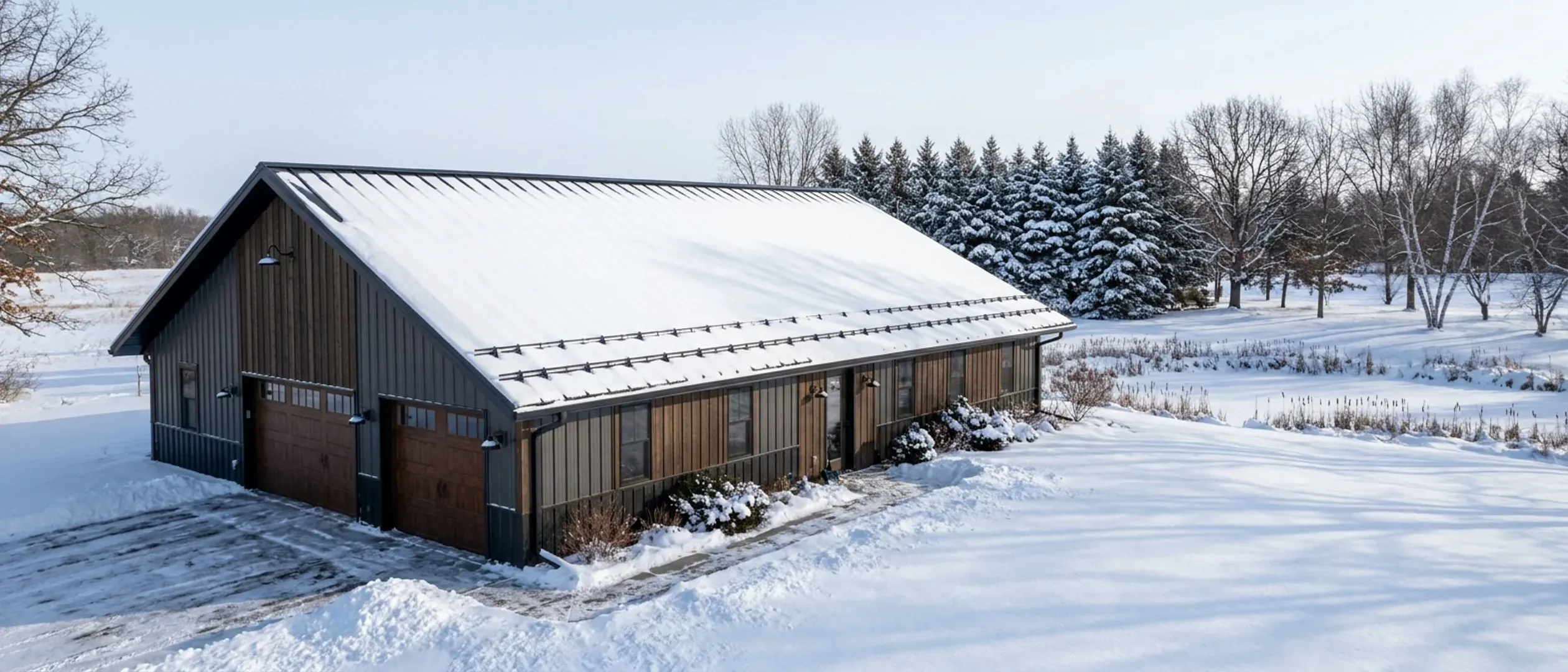
Are Barndominiums Worth It in Minnesota? Value, Appraisal, Winters and the Land
Are barndominiums worth it in Minnesota? For the right owner on the right land, yes: a heated shop and a home under one roof, on acreage, is hard to match with a conventional house and a separate pole building. For others the numbers and the risks point the other way. The answer turns on four things that are specific to Minnesota: whether the county, township or city allows a home on your parcel, and whether it is shoreland; how an appraiser will value an unusual house where comparable sales are thin; what a Minnesota winter will cost you in heat and in condensation control; and the rural projects that come with the land, from the septic system to the well to the road. This guide goes through each and ends with the checks to make before you decide. It does not give prices; the cost guide collects third-party figures.
Figures on this page are cited third-party or government data, not a quote from Minnesota Barndominium Builders.
Bottom Line Up Front
- A barndominium is usually worth it when you would build a large shop anyway, the land already allows a home, and you plan to stay for many years.
- It is usually not worth it when the zoning or shoreland rules are uncertain, you may sell soon, or the loan depends on an appraisal that thin comparable sales may not support.
- Whether a barndominium holds its value depends on how well it reads as a house and how well it handles the cold: a well-insulated, dry building with the shop clearly secondary appraises and resells more easily.
When a barndominium is usually worth it
You need the shop anyway
Equipment, vehicles, a trade or a hobby that needs a heated workspace. Combining the shop and home saves a second foundation and roof and puts the shop a door away in January.
The land already allows a home
The county, township or city has confirmed in writing that a dwelling is permitted, the septic soils work, and the site is outside shoreland and floodplain or you know the rules that apply.
You want open space that can change
Clear-span framing lets the floor plan change as a family does, without moving bearing walls.
You are staying a long time
The value of a barndominium is mostly in the use you get from it. Over many years the shop and the layout pay back; over two or three, resale carries more weight.
When it usually is not
The zoning is uncertain
If it is not clear that a home is allowed, or the parcel is shoreland with tight setbacks, the risk falls on you. Settle it before buying.
You may sell within a few years
Where similar sales are scarce, fewer buyers and appraisers know how to value one. A conventional house resells more predictably.
The loan depends on a high appraisal
If the numbers only work when the appraisal matches the cost to build, thin comparable sales are a real risk.
The shop is bigger than the house needs
Appraisers may give a very large shop little value relative to its cost. Size the shop for what you will use.
What to check before deciding
The zoning and shoreland status, in writing
Ask the county planning office, and the township where it zones, whether a dwelling is allowed on the parcel and what setbacks apply.
The septic and water answer
A septic site evaluation and a conversation with a licensed well contractor before closing.
Who enforces the building code
DLI's Local Code Lookup shows whether your city or township enforces the State Building Code and who the building official is.
A lender that has financed one
Ask how the lender and its appraisers handle barndominiums and large outbuildings before you commit to a plan.
Your county's frost and snow figures
Frost footing depth and ground snow load are set by county in Minnesota Rules part 1303.1600 and part 1303.1700, and they shape the foundation and the frame.
Reading this because you are weighing a build? The next step is a plan drawn for your program.
What's different about Minnesota
The land decides first
Counties zone by ordinance, and townships may zone too as long as their rules are no less restrictive than the county's (Minn. Stat. 394.25 and 394.33). Cities zone within their limits. Land within 1,000 feet of a lake or 300 feet of a river or stream is shoreland, where lot size, water frontage and the placement of the house and septic system follow the local shoreland ordinance (Minn. Stat. 103F.205 and 103F.211). A barndominium is only worth it on land where a home is plainly allowed.
A farm building exemption does not cover a home
Agricultural buildings are exempt from the State Building Code, and state law defines them as structures on agricultural land that are designed, constructed and used to house farm implements, livestock or agricultural products (Minn. Stat. 326B.103 and 326B.121). Living space is not built for that, so a barndominium's home is a house under the code. Plans that count on the exemption to save money on the living quarters do not hold up.
Appraisal on acreage
Fannie Mae's Selling Guide asks appraisers to use comparable sales with similar physical characteristics and, for unique housing, to find evidence of market acceptance; it also asks lenders to confirm that a property with significant outbuildings, such as large barns, is residential in nature. That is why the appraisal, not the construction cost, often decides whether a barndominium is worth it on paper.
Code enforcement protects the value
The State Building Code applies everywhere in Minnesota but is enforced locally only where the city, township or county has adopted it. Minnesota House Research notes that where it is not, there may be no government entity actively monitoring code enforcement, and that lenders or insurers may still require compliance. A barndominium built to code with a paper trail of inspections is easier to finance, insure and sell.
The climate sets the running costs
Minnesota's residential energy code (Minn. R. ch. 1322) sets insulation levels for its cold climate zones, and your designer sizes the insulation for a steel or pole barn shell to meet it. The EPA's moisture guidance explains why cold weather drives condensation onto cold steel and the underside of roofs. A shell insulated and air-sealed to the code costs more to build than a bare pole building, but it is what makes a barndominium comfortable, dry and worth what it cost.
Rural land carries its own projects
Most rural sites need a septic system designed for the soils and permitted by the county, city or township (Minn. Stat. 115.55), and a well, which needs a notification to the Minnesota Department of Health and in most cases a licensed well contractor (Minn. Stat. 103I.205). Add the driveway, power and a road that heavy trucks can use in spring. These are part of the true cost of the barndominium, not extras.
Pros and cons, honestly
Pros
- A heated shop and home on one foundation, under one roof.
- Open, clear-span space that can change over time.
- A metal roof that sheds snow.
- A fast shell that closes in before winter.
Cons
- Appraisal can fall short of the cost to build where similar sales are scarce.
- Insulating and air-sealing a steel or pole barn shell to the energy code is a large share of the work.
- Condensation risk if the envelope is not designed for Minnesota winters.
- Rural land brings septic, well, driveway and road questions of its own.
- An agricultural-building exemption does not cover the living space.
Are barndominiums worth it in Minnesota?
Do barndominiums hold their value in Minnesota?
Is it cheaper to build a barndominium than a house in Minnesota?
Can I build a barndominium as an agricultural building to avoid the building code?
Can I build a barndominium on a lake lot in Minnesota?
Are barndominiums expensive to heat in Minnesota?
Can I get a mortgage on a barndominium?
What should I do before deciding?
Questions answered? Tell us what you want to build and we will put real numbers against it.
Sources
- Minn. Stat. § 394.25 — County official controls (zoning)
- Minn. Stat. § 394.33 — Town powers (planning and zoning)
- Minn. Stat. § 103F.205 — Shoreland definitions
- Minn. Stat. § 103F.211 — Shoreland model standards and criteria
- Minn. Stat. § 326B.103 — State Building Code definitions (agricultural building)
- Minn. Stat. § 326B.121 — State Building Code; application and enforcement
- Minnesota House Research — State Building Code (December 2024)
- Minnesota Department of Labor and Industry — Local Code Lookup (State Building Code jurisdiction directory)
- Minn. R. ch. 1322 — Residential Energy Code
- Minn. R. 1303.1600 — Footing depth for frost protection
- Minn. R. 1303.1700 — Ground snow load
- U.S. EPA — Moisture Control Guidance for Building Design, Construction and Maintenance
- Fannie Mae Selling Guide — B4-1.3-08, Comparable Sales
- Fannie Mae Selling Guide — B4-1.3-05, Improvements Section of the Appraisal Report
- Minn. Stat. § 115.55 — Subsurface sewage treatment systems
- Minn. Stat. § 103I.205 — Well construction
Keep reading
The pages that answer the next question this one raises.
Barndominium pros and cons in Minnesota
Condensation, snow, frost and appraisal in detail.
Read itAre barndominiums legal in Minnesota?
The building code, zoning, shoreland, septic and wells.
Read itBarndominium cost in Minnesota
Third-party cost figures and what drives them.
Read itBarndominium vs house cost
Where the savings are real and where they are not.
Read itBarndominium financing
Loan types and how appraisal affects them.
Read itStart the survey
Tell us about your land and what you want to build.
Read itWant a real number instead of a range?
Start the survey and tell us about your land and what you want to build. Include the county and township, or the parcel number if you have it, because in Minnesota the zoning, the shoreland rules, the septic system and the well can change the budget more than the building does. The survey costs nothing.