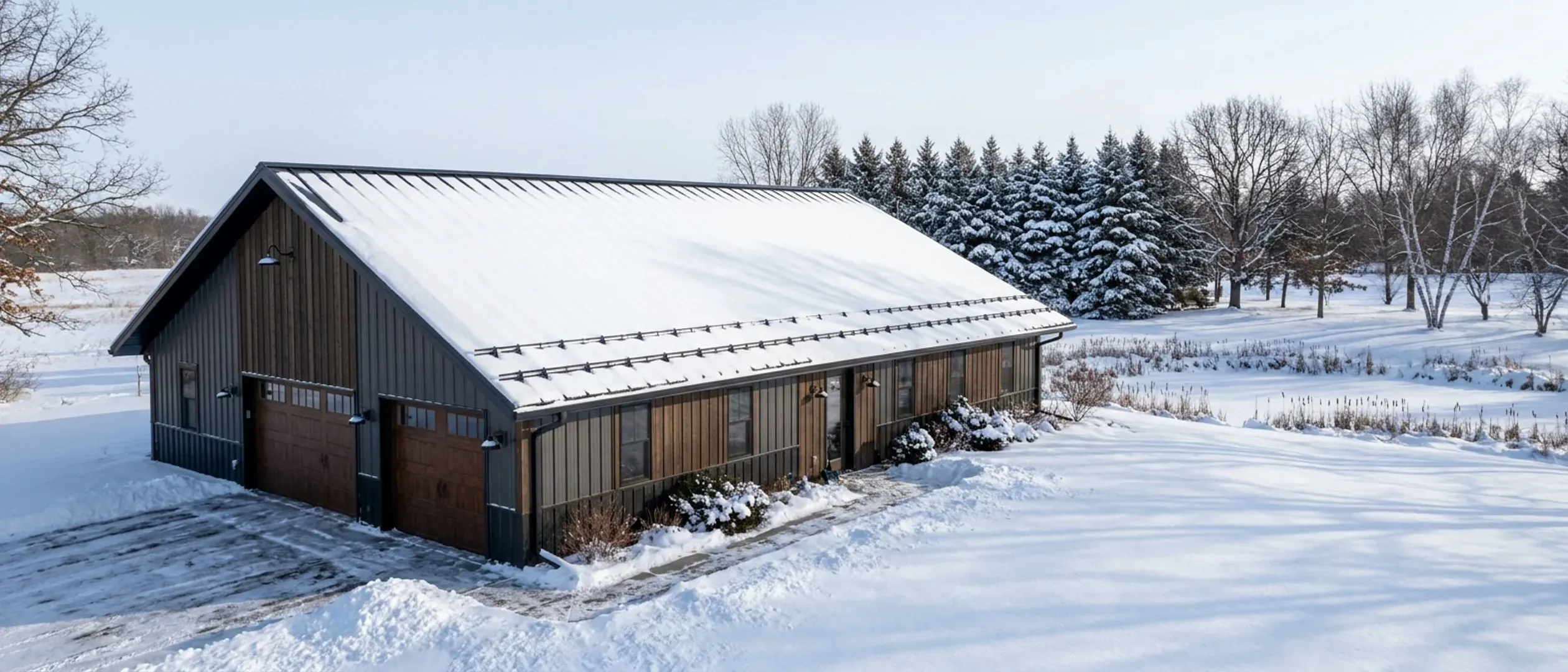
Are Barndominiums Allowed in Minnesota? Codes, Permits and Zoning
Are barndominiums allowed in Minnesota? Yes. No Minnesota law singles them out. A barndominium with living space is a house, and every house in Minnesota is built to one State Building Code, which applies statewide and overrides any local building code. The part that surprises people is enforcement. The code is enforced only where the city, township or county has adopted it, so on some rural land there is no local building permit at all, while in the Twin Cities metro nearly every community issues one. Either way, the code still applies to the building. On top of the code sit the land rules: county, township and city zoning, shoreland rules near lakes and rivers, floodplain ordinances, the septic system and the well. This page explains each layer, cites the statute or rule behind it, shows how to find out who is in charge at a particular address, and ends with the questions to ask before you buy land. It is general information, not legal advice for a specific parcel.
Figures on this page are cited third-party or government data, not a quote from Minnesota Barndominium Builders.
Bottom Line Up Front
- A barndominium is legal in Minnesota as a house. It is built to the State Building Code, which applies statewide, and its living space is not an agricultural building, so the farm-building exemption does not cover it.
- Enforcement varies. Cities, townships and counties enforce the code only where they have adopted it. DLI's Local Code Lookup shows whether yours has; where none has, there may be no building permit, but the code still applies and lenders and insurers may require it.
- The land decides the rest: zoning by the county, township or city, shoreland and floodplain rules near water, a septic system permitted under local ordinances built on MPCA rules, and a well that needs a notification to the Department of Health.
Who is in charge of what
A Minnesota barndominium touches up to five offices. Each has its own rules and its own permit.
The building code
The city, township or county that has adopted the State Building Code issues the building permit, reviews the plans and inspects the work. Where none has, there is no local building permit, but the code still applies to the building.
Zoning
The county, or the township where it zones, or the city inside city limits, decides whether a home is allowed on the parcel, the setbacks, and whether a large accessory building or shop needs its own approval.
Shoreland and floodplain
Land within 1,000 feet of a lake, pond or flowage, or within 300 feet of a river or stream, is shoreland under Minnesota Statutes section 103F.205. The DNR sets model standards for lot size, water frontage and where structures and septic systems go, and counties and cities administer them through their shoreland ordinances (section 103F.211). Local governments must also adopt and enforce floodplain ordinances that regulate the use of land in the floodplain (section 103F.121).
The septic system
The Minnesota Pollution Control Agency sets the rules for subsurface sewage treatment systems (Minnesota Rules chapters 7080 to 7083). Counties must adopt ordinances that comply with them unless every town and city in the county has, and the county, city or township that runs the program issues the permit and requires an inspection of every new system (section 115.55).
The well
Before a new water-supply well is built, a notification must be filed with the Minnesota Department of Health, by the owner, the owner's agent or the licensed well contractor, and most wells must be drilled by a licensed well contractor (section 103I.205). The state notification replaces local well permits unless the Department has delegated that authority.
Where a barndominium can go
The same building can be simple on one parcel and difficult on the next. The zone and the water decide.
Inside a city
City zoning applies and the city almost always enforces the building code. Lots are usually small and city zoning can limit the size and placement of buildings, so ask the planning department whether a metal-clad home with an attached shop fits the district.
Rural land zoned by the county
The county zoning ordinance decides whether a dwelling is allowed in the district, the minimum lot size and the setbacks. Agricultural and rural residential districts differ from county to county, so read the ordinance for the parcel's district rather than a neighbour's.
Townships with their own zoning
Some townships zone, and their rules can be stricter than the county's. Some also enforce the building code. Ask the township clerk as well as the county.
Near a lake or river
Shoreland rules set larger lots, frontage and setbacks, and they differ by the waterbody's DNR classification. A barndominium on a lake lot is possible, but the house and septic system have to fit the shoreland standards.
Just outside a city
A city may extend building code enforcement up to two miles into a neighbouring township with the township board's permission, so land just outside town can come under the city's building official.
Where the code is enforced, and where it is not
Where it is enforced
You apply for a building permit, the plans are reviewed against the Minnesota Residential Code and energy code, and the building official inspects footings, framing, insulation and the final. Nearly all of the Twin Cities metro works this way.
Where it is not
There is no local building permit or inspection, but the code still applies to the building. Minnesota House Research notes that lenders and insurers may require compliance anyway, and zoning, shoreland, septic and well rules apply as they do everywhere.
Why building to code matters either way
A construction lender, an insurer and a future buyer's appraiser and inspector all look for a house built to code. Frost-depth footings, the county's snow load, radon control and energy-code insulation protect the building whether or not anyone inspects them.
Septic and wells in more detail
Septic design follows the soil
A designer evaluates the soils and sizes the system to the local ordinance, which can be stricter than the state minimum. MPCA publishes a licensed-business search for septic designers and installers.
Every new system is inspected
State law requires an inspection of every new or replacement septic system. The local ordinance sets how and when.
Wells start with a notification
The well notification goes to the Minnesota Department of Health before drilling, and the Department's well program oversees construction and the sealing of old wells.
Questions to ask before you buy land or apply
Is a dwelling allowed in this zoning district?
Ask the county planning and zoning office, and the township if it zones, for the answer in writing, with the setbacks and any limits on accessory buildings.
Is the parcel shoreland or in a floodplain?
Ask the county or city, and check how the nearest lake or river is classified.
Who enforces the building code here?
Look up the city or township on DLI's Local Code Lookup and confirm with the county.
Will the soils support a septic system?
A septic site evaluation before closing tells you whether the parcel can take a system and where the house can go.
What are the county's frost and snow figures?
Minnesota Rules parts 1303.1600 and 1303.1700 set them by county, and they shape the foundation and frame.
Reading this because you are weighing a build? The next step is a plan drawn for your program.
What's different about Minnesota
One building code for the whole state
Minnesota Statutes section 326B.121 says the State Building Code is the standard that applies statewide for the construction of buildings and that it supersedes the building code of any municipality. For houses, the core is the Minnesota Residential Code, Minnesota Rules chapter 1309, which adopts the 2018 International Residential Code with state amendments, alongside the residential energy code in chapter 1322 and the Minnesota provisions in chapter 1303. The Department of Labor and Industry (DLI) has begun work on an update based on the 2024 International Residential Code; it is not yet adopted, and no effective date had been set in September 2026. A barndominium is designed to the same code as any other house.
Enforced only where a city, township or county has adopted it
DLI puts it plainly: the code is the minimum construction standard throughout Minnesota, including all cities, townships and counties, but it is not enforceable by a municipality unless adopted by local ordinance. Under section 326B.121, a city, township or county that had adopted the code by January 1, 2008 must keep enforcing it, except small communities of under 2,500 people outside the metropolitan counties; any other may choose to adopt it. A city can also, with the township board's permission, extend enforcement up to two miles beyond its limits. Minnesota House Research notes that where no local government has adopted enforcement, there may be no government entity actively monitoring the code, yet the code still applies, and lenders or insurers may require compliance.
How to find out who enforces it at your address
DLI's Local Code Lookup, its State Building Code jurisdiction directory, shows for each city and township whether it has adopted the building code. The pattern is stark. In the metro counties of Dakota, Scott and Carver every listed city and township had adopted it when the directory was read in September 2026, while in Itasca County 3 of 102 listed places had, in Beltrami County only the city of Bemidji had, and in St. Louis County 11 of 187 had. Check the directory and then call the county, because a county-wide adoption covers the townships inside it.
The state sets frost depth, snow load and radon rules
Minnesota Rules part 1303.1600 sets the minimum footing depth for frost at five feet in the 34 northern counties it lists as Zone I and three and a half feet in the other 53, unless an engineer competent in soil mechanics determines otherwise. Part 1303.1700 sets the ground snow load used in design at 60 pounds per square foot in 29 listed counties and 50 in all others. Parts 1303.2400 to 1303.2402 require passive radon control in new homes built with a slab, a basement or an attached garage that is not sealed from the living space. These are the state code's standards wherever the house is built.
The farm-building exemption does not cover a home
The State Building Code does not govern agricultural buildings (section 326B.121), and section 326B.103 defines those as structures on agricultural land that are designed, constructed and used to house farm implements, livestock or agricultural products, and used by the owner, family, employees and people picking up or delivering farm products. Living quarters are not built or used for that, so a barndominium's home is a house under the code. A machine shed or barn with no living space may qualify, and the local building official decides that case by case.
Who has to hold a residential contractor licence
Under sections 326B.802 and 326B.805, anyone in the business of building homes, or contracting with an owner to build one, by providing two or more of the special skills the statute lists, such as excavation, concrete, framing, insulation, siding and drywall, must be licensed by DLI as a residential building contractor. Exemptions include an owner who builds a home to live in, or to keep as a rental, and not for resale or speculation, and a supplier or manufacturer who furnishes materials without installing them. Before signing, check any contractor on DLI's license and registration lookup.
Counties, townships and cities all zone
Counties adopt zoning by ordinance (section 394.25). Townships may plan and zone too, but once the county has adopted zoning a township's rules cannot be less restrictive than the county's, though they can be stricter, including on shoreland (section 394.33). Cities zone within their limits, regulating the location, size, foundation type and use of buildings (section 462.357). In practice the first call for rural land is the county planning and zoning office, and the second is the township clerk.
Pros and cons, honestly
Pros
- One statewide building code, so the construction standard is the same in every county.
- State-set frost depth and ground snow load by county make the design figures easy to confirm.
- Rural land outside enforcing jurisdictions has no local building permit to wait for.
- A barndominium is treated as a house, with no special rules singling it out.
Cons
- Enforcement varies by city, township and county, so the permit path differs from one parcel to the next.
- Where nobody enforces the code, no inspector catches mistakes, and a lender or buyer may still expect code compliance.
- County, township and city zoning can all apply, and township rules can be stricter than the county's.
- Shoreland and floodplain rules near Minnesota's lakes and rivers can limit lot size, placement and the septic system.
- The farm-building exemption does not cover the living space.
Are barndominiums allowed in Minnesota?
Are barndominiums legal in Minnesota?
Do I need a building permit for a barndominium in Minnesota?
Does the building code apply in townships that do not enforce it?
Can I build a barndominium on agricultural land in Minnesota?
Can I live in my pole barn or shop in Minnesota?
Can I build my own barndominium without a contractor's licence?
How deep do footings have to be in Minnesota?
Do I need a septic permit?
Can I build a barndominium on a lake lot?
Questions answered? Tell us what you want to build and we will put real numbers against it.
Sources
- Minn. Stat. § 326B.121 — State Building Code; application and enforcement
- Minn. Stat. § 326B.103 — State Building Code definitions (agricultural building, municipality)
- Minnesota Department of Labor and Industry — Overview of the Minnesota State Building Code
- Minnesota House Research — State Building Code (December 2024)
- Minnesota Department of Labor and Industry — Local Code Lookup (State Building Code jurisdiction directory)
- Minn. R. 1309.0010 — Adoption of the International Residential Code
- Minn. R. ch. 1322 — Residential Energy Code
- Minn. R. 1303.1600 — Footing depth for frost protection
- Minn. R. 1303.1700 — Ground snow load
- Minn. R. 1303.2400 — Radon control, purpose and scope
- Minn. Stat. § 326B.802 — Residential contractor definitions
- Minn. Stat. § 326B.805 — Residential contractor licensing requirements
- Minnesota Department of Labor and Industry — License and registration lookup
- Minn. Stat. § 394.25 — County official controls (zoning)
- Minn. Stat. § 394.33 — Town powers (planning and zoning)
- Minn. Stat. § 462.357 — Municipal zoning ordinances
- Minn. Stat. § 103F.205 — Shoreland definitions
- Minn. Stat. § 103F.211 — Shoreland model standards and criteria
- Minn. Stat. § 103F.121 — Floodplain management ordinances
- Minnesota DNR — Shoreland Management Program
- Minnesota DNR — Floodplain Management
- Minn. Stat. § 115.55 — Subsurface sewage treatment systems
- Minnesota Pollution Control Agency — Septic systems
- Minn. Stat. § 103I.205 — Well construction
- Minnesota Department of Health — Wells and Borings
Keep reading
The pages that answer the next question this one raises.
Barndominium build timeline
Where zoning, septic and the permit fall in the schedule, and the frost season.
Read itBarndominium pros and cons in Minnesota
Condensation, snow loads, frost footings and appraisal.
Read itAre barndominiums worth it in Minnesota?
When the shop-plus-home case holds.
Read itPermitting
How the permit process works for a barndominium.
Read itSite preparation
Driveway, pad, utilities and septic coordination.
Read itService areas
Local permit, zoning and septic notes by city and county.
Read itStart the survey
Tell us about your land and what you want to build.
Read itWant a real number instead of a range?
Start the survey and tell us about your land and what you want to build. Include the county and township, or the parcel number if you have it, because in Minnesota the zoning, the shoreland rules, the septic system and the well can change the budget more than the building does. The survey costs nothing.